History of animation
From Wikipedia, the free encyclopedia
Animation refers to the creation of a sequence of images—drawn, painted, or produced by other artistic methods—that change over time to portray the illusion of motion. Before the invention of film, humans depicted motion in static art as far back as the Paleolithic period. In the 1st century, several devices successfully depicted motion in animated images.
Early approaches to motion in art[edit]


One early example is a 5,200-year old pottery bowl discovered in Shahr-e Sukhteh, Iran. The bowl has five images painted around it that show phases of a goat leaping up to nip at a tree.[1][2]
An Egyptian mural approximately 4000 years old, found in the tomb ofKhnumhotep at the Beni Hassan cemetery, features a very long series of images that apparently depict the sequence of events in a wrestlingmatch.[3] Ancient Chinese records contain several mentions of devices, including one made by the inventor Ding Huan, that were said to "give an impression of movement" to a series of human or animal figures on them,[4] but these accounts are unclear and may only refer to the actual movement of the figures through space.[5]
Seven drawings by Leonardo da Vinci (c. 1510) extending over two folios in the Windsor Collection, Anatomical Studies of the Muscles of the Neck, Shoulder, Chest, and Arm, have detailed renderings of the upper body and less-detailed facial features. The sequence shows multiple angles of the figure as it rotates and the arm extends. Because the drawings show only small changes from one image to the next, together they imply the movement of a single figure.
Although some of these early examples may seem similar to a series of animation drawings, the contemporary lack of any means to show them in motion and their extremely lowframe rate causes them to fall short of being true animation. Nonetheless, the practice of illustrating movement over time by creating a series of images arranged in chronological order provided a foundation for the development of the art.
Animation before film[edit]
Numerous devices that successfully displayed animated images were introduced well before the advent of the motion picture. These devices were used to entertain, amaze, and sometimes even frighten people. The majority of these devices didn't project their images, and accordingly could only be viewed by a single person at any one time. For this reason they were considered toys rather than devices for a large scale entertainment industry like later animation. Many of these devices are still built by and for film students learning the basic principles of animation.
The magic lantern (c. 1650)[edit]
The magic lantern is an early predecessor of the modern day projector. It consisted of a translucent oil painting, a simple lens and a candle or oil lamp. In a darkened room, the image would appear projected onto an adjacent flat surface. It was often used to project demonic, frightening images in a phantasmagoria that convinced people they were witnessing the supernatural. Some slides for the lanterns contained moving parts, which makes the magic lantern the earliest known example of projected animation. The origin of the magic lantern is debated, but in the 15th century the Venetian inventor Giovanni Fontana published an illustration of a device that projected the image of a demon in his Liber Instrumentorum. The earliest known actual magic lanterns are usually credited to Christiaan Huygens or Athanasius Kircher.[6][7]
Thaumatrope (1824)[edit]
A thaumatrope is a simple toy that was popular in the 19th century. It is a small disk with different pictures on each side, such as a bird and a cage, and is attached to two pieces of string. When the strings are twirled quickly between the fingers, the pictures appear to combine into a single image. This demonstrates the persistence of vision, the fact that the perception of an object by the eyes and brain continues for a small fraction of a second after the view is blocked or the object is removed. The invention of the device is often credited to Sir John Herschel, but John Ayrton Paris popularized it in 1824 when he demonstrated it to the Royal College of Physicians.[8]
Phenakistoscope (1831)[edit]

The phenakistoscope was an early animation device.[9] It was invented in 1831, simultaneously by the Belgian Joseph Plateau and the Austrian Simon von Stampfer. It consists of a disk with a series of images, drawn on radii evenly spaced around the center of the disk. Slots are cut out of the disk on the same radii as the drawings, but at a different distance from the center. The device would be placed in front of amirror and spun. As the phenakistoscope spins, a viewer looks through the slots at the reflection of the drawings, are momentarily visible when a slot passes by the viewer's eye.[10] This created the illusion of animation.
Zoetrope (1834)[edit]
The zoetrope concept was suggested in 1834 by William George Horner, and from the 1860s marketed as the zoetrope. It operates on the same principle as the phenakistoscope. It was a cylindrical spinning device with several frames of animation printed on a paper strip placed around the interior circumference. The observer looks through vertical slits around the sides to view the moving images on the opposite side as the cylinder spins. As it spins, the material between the viewing slits moves in the opposite direction of the images on the other side and in doing so serves as a rudimentary shutter. The zoetrope had several advantages over the basic phenakistoscope. It did not require the use of a mirror to view the illusion, and because of its cylindrical shape it could be viewed by several people at once.[11]
In ancient China, people used a device that one 20th century historian categorized as "a variety of zoetrope."[4] It had a series of translucent paper or mica panels and was operated by being hung over a lamp so that vanes at the top would cause it to rotate as heated air rose from the lamp. It has been claimed that this rotation, if it reached the ideal speed, caused the same illusion of animation as the later zoetrope, but because there was no shutter (the slits in a zoetrope) or other provision for intermittence, the effect was in fact simply a series of horizontally drifting figures, with no true animation.[12][13][14]
Flip book (1868)[edit]
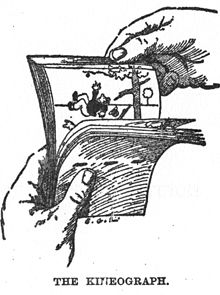
John Barnes Linnett patented the first flip book in 1868 as the kineograph. A flip book is a small book with relatively springy pages, each having one in a series of animation images located near its unbound edge. The user bends all of the pages back, normally with the thumb, then by a gradual motion of the hand allows them to spring free one at a time. As with the phenakistoscope, zoetrope and praxinoscope, the illusion of motion is created by the apparent sudden replacement of each image by the next in the series, but unlike those other inventions no view-interrupting shutter or assembly of mirrors is required and no viewing device other than the user's hand is absolutely necessary. Early film animators cited flip books as their inspiration more often than the earlier devices, which did not reach as wide an audience.[15]
The older devices by their nature severely limit the number of images that can be included in a sequence without making the device very large or the images impractically small. The book format still imposes a physical limit, but many dozens of images of ample size can easily be accommodated. Inventors stretched even that limit with the mutoscope, patented in 1894 and sometimes still found in amusement arcades. It consists of a large circularly-bound flip book in a housing, with a viewing lens and a crank handle that drives a mechanism that slowly rotates the assembly of images past a catch,size to match the running time of an entire reel of film.
Praxinoscope (1877)[edit]
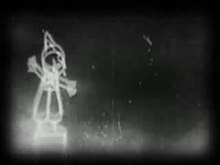
The first known animated projection on a screen was created in France by Charles-Émile Reynaud, who was a French science teacher. Reynaud created the Praxinoscope in 1877 and the Théâtre Optique in December 1888. On 28 October 1892, he projected the first animation in public, Pauvre Pierrot, at the Musée Grévin in Paris. This film is also notable as the first known instance of film perforations being used. His films were not photographed, but drawn directly onto the transparent strip. In 1900, more than 500,000 people attended these screenings.
Traditional animation[edit]
The first film recorded on standard picture film that included animated sequences was the 1900 Enchanted Drawing, which was followed by the first entirely animated film, the 1906 Humorous Phases of Funny Faces by J. Stuart Blackton—who is, for this reason, considered the father of American animation.
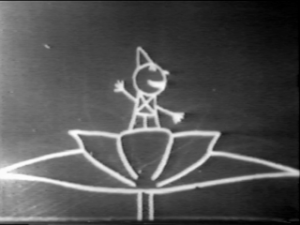
In Europe, the French artist, Émile Cohl, created the first animated film using what came to be known as traditional animationcreation methods—the 1908 Fantasmagorie. The film largely consisted of a stick figure moving about and encountering all manner of morphing objects, such as a wine bottle that transforms into a flower. There were also sections of live action where the animator’s hands would enter the scene. The film was created by drawing each frame on paper and then shooting each frame onto negative film, which gave the picture a blackboard look.
The more detailed hand-drawn animations, requiring a team of animators drawing each frame manually with detailed backgrounds and characters, were those directed by Winsor McCay, a successful newspaper cartoonist, including the 1911Little Nemo, the 1914 Gertie the Dinosaur, and the 1918 The Sinking of the Lusitania.[16][17]
During the 1910s, the production of animated short films, typically referred to as "cartoons", became an industry of its own and cartoon shorts were produced for showing in movie theaters. The most successful producer at the time was John Randolph Bray, who, along with animator Earl Hurd, patented the cel animation process that dominated the animation industry for the rest of the decade.[18]
The silent era[edit]
Charles-Émile Reynaud's Théâtre Optique is the earliest known example of projected animation. It predates even photographic motion picture devices such as Thomas Edison's 1893 invention, the Kinetoscope, and the Lumière brothers' 1894 invention, the cinematograph. Reynaud exhibited three of his animations on October 28, 1892 at Musée Grévin in Paris, France. The only surviving example of these three is Pauvre Pierrot, which was 500 frames long.[19]
After the cinematograph popularized the motion picture, producers began to explore the endless possibilities of animation in greater depth.[20] A short stop-motion animation was produced in 1908 by Albert E. Smith and J. Stuart Blackton called The Humpty Dumpty Circus.[21] Stop motion is a technique in which real objects are moved around in the time between their images being recorded, so that when the images are viewed at a normal frame rate the objects appear to move by some invisible force. It directly descends from various early trick film techniques that created the illusion of impossible actions.
A few other films that featured stop motion technique were released afterward, but the first to receive wide scale appreciation was Blackton's Haunted Mansion, which baffled viewers and inspired much further development.[22] In 1906, Blackton also made the first drawn work of animation on standard film, Humorous Phases of Funny Faces. It features faces that are drawn on a chalkboard and then suddenly move autonomously.
Fantasmagorie, by the French director Émile Cohl (also called Émile Courtet), is also noteworthy. It was screened for the first time on August 17, 1908 at Théâtre du Gymnase in Paris. Cohl later went to Fort Lee, New Jersey near New York City in 1912, where he worked for French studio Éclair and spread its animation technique to the US.
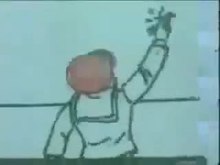
Katsudō Shashin, from an unknown creator, was discovered in 2005 and is speculated to be the oldest work of animation in Japan, with Natsuki Matsumoto,[a][23] an expert in iconography at the Osaka University of Arts[24] and animation historian Nobuyuki Tsugata[b]determining the film was most likely made between 1907 and 1911.[25] The film consists of a series of cartoon images on fifty frames of acelluloid strip and lasts three seconds at sixteen frames per second.[26] It depicts a young boy in a sailor suit who writes the kanjicharacters "活動写真" (katsudō shashin, or "moving picture"), then turns towards the viewer, removes his hat, and offers a salute.[26]Evidence suggests it was mass-produced to be sold to wealthy owners of home projectors.[27] To Matsumoto, the relatively poor quality and low-tech printing technique indicate it was likely from a smaller film company.[28]
Influenced by Émile Cohl, the author of the first puppet-animated film (i.e., The Beautiful Lukanida (1912)), Russian-born (ethnicallyPolish) director Wladyslaw Starewicz, known as Ladislas Starevich, started to create stop motion films using dead insects with wire limbs and later, in France, with complex and really expressive puppets. In 1911, he created The Cameraman's Revenge, a complex tale oftreason,and violence between several different insects. It is a pioneer work of puppet animation, and the oldest animated film of such dramatic complexity, with characters filled with motivation, desire and feelings.
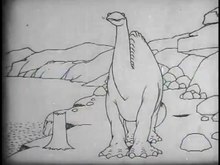
In 1914, American cartoonist Winsor McCay released Gertie the Dinosaur, an early example of character development in drawn animation. The film was made for McCay's vaudeville act and as it played McCay would speak to Gertie who would respond with a series of gestures. There was a scene at the end of the film where McCay walked behind the projection screen and a view of him appears on the screen showing him getting on the cartoon dinosaur's back and riding out of frame. This scene made Gertie the Dinosaur the first film to combine live action footage with hand drawn animation. McCay hand-drew almost every one of the 10,000 drawings he used for the film.[29]
Also in 1914, John Bray opened John Bray Studios, which revolutionized the way animation was created. Earl Hurd, one of Bray's employees patented the cel technique. This involved animating moving objects on transparent celluloid sheets. Animators photographed the sheets over a stationary background image to generate the sequence of images. This, as well as Bray's innovative use of the assembly line method, allowed John Bray Studios to create Colonel Heeza Liar, the first animated series.[30]
In 1915, Max and Dave Fleischer invented rotoscoping, the process of using film as a reference point for animation and their studios went on to later release such animated classics as Ko-Ko the Clown, Betty Boop, Popeye the Sailor Man, and Superman. In 1918 McCay released The Sinking of the Lusitania, a wartime propaganda film. McCay did use some of the newer animation techniques, such as cels over paintings—but because he did all of his animation by himself, the project wasn't actually released until just shortly before the end of the war.[30] At this point the larger scale animation studios were becoming the industrial norm and artists such as McCay faded from the public eye.[29]

The first known animated feature film was El Apóstol, made in 1917 by Quirino Cristiani from Argentina.[31] He also directed two other animated feature films, including 1931's Peludópolis, the first feature length animation to use synchronized sound. None of these, however, survive.[32][33]
In 1920, Otto Messmer of Pat Sullivan Studios created Felix the Cat. Pat Sullivan, the studio head took all of the credit for Felix, a common practice in the early days of studio animation. Felix the Cat was distributed by Paramount Studios, and it attracted a large audience. Felix was the first cartoon to be merchandised. He soon became a household name.
In Germany, during the 1920s the abstract animation was invented by Walter Ruttman, Hans Richter, and Oskar Fischinger, however, theNazis censorship against so-called "degenerate art" prevented the abstract animation from developing after 1933.
The earliest surviving animated feature film is the 1926 silhouette-animated Adventures of Prince Achmed, which used colour-tinted film. It was directed by German Lotte Reiniger and French/Hungarian Berthold Bartosch.
Walt Disney & Warner Bros.[edit]
In 1923, a studio called Laugh-O-Grams went bankrupt and its owner, Walt Disney, opened a new studio in Los Angeles. Disney's first project was the Alice Comedies series, which featured a live action girl interacting with numerous cartoon characters. Disney's first notable breakthrough was 1928's Steamboat Willie, the third of the Mickey Mouseseries. It was the first cartoon that included a fully post-produced soundtrack, featuring voice and sound effects printed on the film itself ("sound-on-film"). The short film showed an anthropomorphic mouse named Mickey neglecting his work on a steamboat to instead make music using the animals aboard the boat.
In 1933, Warner Brothers Cartoons was founded. While Disney's studio was known for its releases being strictly controlled by Walt Disney himself, Warner brothers allowed its animators more freedom, which allowed for their animators to develop more recognizable personal styles.[29]
The first animation to use the full, three-color Technicolor method was Flowers and Trees, made in 1932 by Disney Studios, which won an Academy Award for the work.[19] Color animation soon became the industry standard, and in 1934, Warner Brothers released Honeymoon Hotel of the Merrie Melodies series, their first color films. Meanwhile, Disney had realized that the success of animated films depended upon telling emotionally gripping stories; he developed an innovation called a "story department" where storyboard artists separate from the animators would focus on story development alone, which proved its worth when the Disney studio released in 1933 the first-ever animated short to feature well-developed characters, Three Little Pigs.[34][35][36] In 1935, Tex Avery released his first film with Warner Brothers. Avery's style was notably fast paced, violent, and satirical, with a slapstick sensibility.
Snow White and the Seven Dwarfs[edit]
Many consider Walt Disney's 1937 Snow White and the Seven Dwarfs the first animated feature film, though at least seven films were released earlier. However, Disney's film was the first one completely made using hand-drawn animation. The previous seven films, of which only four survive, were made using cutout, silhouette or stop motion, except for one—also made by Disney seven months prior to Snow White's release—Academy Award Review of Walt Disney Cartoons. This was an anthology film to promote the upcoming release of Snow White. However, many do not consider this a genuine feature film because it is a package film. In addition, at approximately 41 minutes, the film does not seem to fulfill today's expectations for a feature film. However, the official BFI, AMPAS and AFI definitions of a feature film require that it be over 40 minutes long, which, in theory, should make it the first animated feature film using traditional animation.
But as Snow White was also the first one to become successful and well-known within the English-speaking world, people tend to disregard the seven films. Following Snow White's release, Disney began to focus much of its productive force on feature-length films. Though Disney did continue to produce shorts throughout the century, Warner Brothers continued to focus on features.
The television era[edit]
Color television was introduced to the US Market in 1951. In 1958, Hanna-Barbera released Huckleberry Hound, the first half-hour television program to feature only animation.Terrytoons released Tom Terrific the same year.[37] In 1960, Hanna-Barbera released another monumental animated television show, The Flintstones, which was the first animated series on prime time television. Television significantly decreased public attention to the animated shorts being shown in theatres.
Animation Techniques[edit]
Innumerable approaches to creating animation have arisen throughout the years. Here is a brief account of some of the non traditional techniques commonly incorporated.
Stop motion[edit]
This process is used for many productions, for example, the most common types of puppets are clay puppets, as used in The California Raisins , Wallace and Gromit and Shaun the Sheep by Aardman, and figures made of various rubbers, cloths and plastic resins, such as The Nightmare Before Christmas and James and the Giant Peach. Sometimes even objects are used, such as with the films of Jan Švankmajer.
Stop motion animation was also commonly used for special effects work in many live-action films, such as the 1933 version of King Kong and The 7th Voyage of Sinbad.
CGI animation[edit]
Computer-generated imagery (CGI) revolutionized animation. The first fully computer-animated feature film was Pixar's Toy Story (1995).[citation needed] The process of CGI animation is still very tedious and similar in that sense to traditional animation, and it still adheres to many of the same principles.
A principal difference of CGI animation compared to traditional animation is that drawing is replaced by 3D modeling, almost like a virtual version of stop-motion. A form of animation that combines the two and uses 2D computer drawing can be considered computer aided animation.
Most CGI created films are based on animal characters, monsters, machines, or cartoon-like humans. Animation studios are now trying to develop ways to create realistic-looking humans. Films that have attempted this include Final Fantasy: The Spirits Within in 2001, Final Fantasy: Advent Children in 2005, The Polar Express in 2004, Beowulf in 2007 and Resident Evil: Degeneration in 2009. However, due to the complexity of human body functions, emotions and interactions, this method of animation is rarely used. The more realistic a CG character becomes, the more difficult it is to create the nuances and details of a living person, and the greater the likelihood of the character falling into the uncanny valley. The creation of hair and clothing that move convincingly with the animated human character is another area of difficulty. The Incredibles and Up both have humans as protagonists, while films like Avatar combine animation with live action to create humanoid creatures.
Cel-shading is a type of non-photorealistic rendering intended to make computer graphics appear hand-drawn. It is often used to mimic the style of a comic book or cartoon. It is a somewhat recent addition to computer graphics, most commonly turning up in console video games. Though the end result of cel-shading has a very simplistic feel like that ofhand-drawn animation, the process is complex. The name comes from the clear sheets of acetate (originally, celluloid), called cels, that are painted on for use in traditional 2D animation. It may be considered a "2.5D" form of animation. True real-time cel-shading was first introduced in 2000 by Sega's Jet Set Radio for their Dreamcast console. Besides video games, a number of anime have also used this style of animation, such as Freedom Project in 2006.
Machinima is the use of real-time 3D computer graphics rendering engines to create a cinematic production. Most often, video games are used to generate the computer animation. Machinima-based artists, sometimes called machinimists or machinimators, are often fan laborers, by virtue of their re-use of copyrighted materials.
Source: https://en.wikipedia.org/wiki/History_of_animation